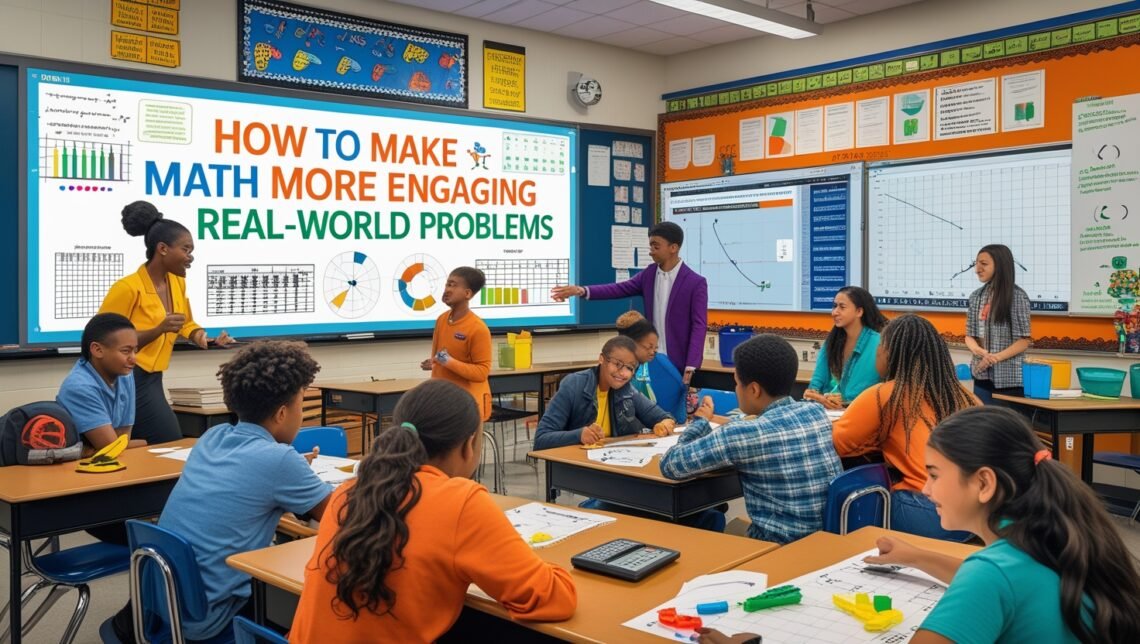
Maths seems to be a boring and difficult subject for many students, but when maths is linked to real-life issues, its effect is very different. When students start to understand that what they are learning in the classroom can be useful in their everyday life, they naturally become more motivated and actively participate in the learning process. Math concepts become meaningful with real-world problems. Students feel that they are not learning some useless formula but rather acquiring a skill that will be useful to them at some point in their lives. If they are told how to do it, their budgeting system is based on fractions and percentages, or how discounts and sales prices are calculated.
They become more interested in these concepts. In this way, maths becomes more logical and practical for them. When teachers also use examples that are related to the students’ lives, they grab their attention, and they understand the concepts better. This approach proves helpful not only in improving understanding but also in developing the students’ critical thinking, problem-solving, and decision-making skills. When cognitive engagement increases, retention also improves, and learning is sustained for the long term. Therefore, real-world problems are included in maths lessons. Doing maths is an important and powerful strategy that teaches every student to connect maths with life.
Benefits of Incorporating Real-Life Context in Math:
When real-life context is included in the teaching of math, its effect is not limited to just the interest of the students, but it improves their understanding and skills more deeply.
The first benefit is that students do not just memorize the concepts but start understanding them. When they see that they can solve a problem in their life through math, they naturally get involved in that concept.
The second benefit is that real-life problems activate their critical thinking and logical reasoning. They have to analyze and make plans. And steps have to be followed which develop their problem-solving skills.
Third, when they apply mathematics in a real scenario, their confidence increases, they feel capable, and their self-esteem improves.
Fourth, it also promotes collaboration and communication skills in the real-world context. When there are group projects or discussions, students share their ideas, listen to others’ talks, and find solutions together, thus their social interaction also improves, and they learn teamwork.
Fifth, such learning methods prepare them for the future, where they have to face real problems in the real world. It will happen that if they start learning maths in realistic scenarios from school days themselves, then using maths in their careers becomes easy and natural for them. Hence, maths in a real-life context not only becomes engaging but also deeply effective.
Types of Real‑World Math Problems to Use in Class:
When math has to be connected to real-life issues, the first question that arises is what problems should be used that are not just relevant but also understandable to students and pique their interest. Many such topics can be meaningful for students of all ages, such as financial literacy, which includes understanding budgeting, shopping expenses, discounts, and interest rates. These things are a part of everyone’s daily experience, so students are naturally interested in them. Then cooking and recipe-related problems are also very effective, where fractions, ratios, and conversions are used. When it is explained how to double a recipe or make something in half, they see the basic operations of maths realistically. Transport and travel-based scenarios are also quite engaging. Problems like calculating distance, speed, time, and fuel consumption make the students understand the practical use of measurement and algebra. Examples of construction and architecture are also useful for the concepts of geometry, area, and volume. Analysis of sports statistics or game scores also makes data handling and averages real. Graphs and trends can also be introduced through weather data or temperature charts. The biggest advantage of such problems is that students see that maths is not just confined to the paper, but there is a place hidden in their life, and this understanding deeply enriches their learning experience.
Project-Based and Problem-Based Learning:
Project-based and problem-based learning are two teaching methods that have become the best way to effectively incorporate real-world math problems in classrooms. The difference between the two approaches is that in project-based learning, students complete a long project in which they do research, collect data, analyze it, and then demonstrate their solutions through a presentation or physical model, whereas in problem-based learning, students are given a complex, open-ended problem that they have to solve. Both approaches make students active learners, where they do not just listen but think, understand, and apply math theories and operations in these methods.
Any topic is explored through a real situation, for example, if the issue of water wastage is given, then students calculate how much water is wasted daily, how it can be saved, and what solutions can be found. This is not just a way of learning mathematics; students also learn social responsibility. Project-based learning increases their time management, research skills, and collaboration, while problem-based learning develops critical and analytical thinking. Both methods increase students’ ownership, keep them actively engaged, and maintain their interest. These approaches transform a teacher-centered class into a student-centered one, where students themselves become responsible for their learning.
Engaging Tools and Strategies:
To make math engaging, it is very important to use tools and strategies. Every student has a different learning style. Some students understand better by watching, some by doing, and some by listening. Therefore, the use of visual aids such as diagrams, graphs, manipulatives, and interactive whiteboards helps in understanding concepts more clearly. When a student watches a student solve an equation on the whiteboard, he or she remembers the process well. Discussions are also a powerful strategy in which students share their ideas and learn from each other. Think-pair-share or group discussions make math concepts social and accessible.
When students discuss solutions to real problems among themselves, their communication and logical reasoning skills improve Outdoor activities such as math walks and scavenger hunts are also ways of connecting maths with movement and observation Nowadays, digital games and apps also make learning fun Platforms like Prodigy or GeoGebra provide interactive exercises where students reinforce concepts without pressure Gamification increases motivation and the reward system inspires students to practice repeatedly Apart from this, storytelling and scenario-based learning are also creative ways of linking real life and maths The aim of all these tools and strategies is that maths should not seem like an abstract and dry subject but rather it should be engaging, understandable and relevant to every student become.
Conclusion:
Today, when students constantly ask how these things will be useful in their lives, it has become important for teachers to teach math in such a way that students understand its real-world relevance. Instead of relegating math to the classroom, if we introduce it through life issues, students are more interested in it and are able to understand the concepts better. When they see that math is used in everyday tasks like budgeting, shopping, traveling, or cooking, they are more naturally engaged, and we understand that Mathematics is a living subject. Teaching approaches like project-based learning, problem-solving tasks, and collaborative discussions make students active learners.
These learning methods also strengthen their decision-making, critical thinking, and communication skills The use of visuals, discussions, games, and real data also proves to be very beneficial in making Mathematics engaging The most important thing is that when students feel that they can use Mathematics in the real world, their confidence increases and they enjoy using Mathematics rather than being afraid of it. In this way, a classroom culture develops where learning Mathematics becomes an exploration, and students learn to connect it with their lives.
FAQs:
- Why is it important to connect math with real-world problems?
Connecting math with real-world problems helps students understand the relevance and practical use of what they’re learning. It transforms abstract concepts into meaningful tools they can use in daily life, such as budgeting, shopping, or cooking. This not only increases engagement but also enhances understanding, critical thinking, and long-term retention. - What are some examples of real-world math problems that can be used in the classroom?
Examples include financial literacy tasks (like calculating discounts, interest rates, and budgeting), recipe conversions, travel planning (distance, speed, and time), construction measurements, sports statistics, and weather data analysis. These scenarios make math more tangible and relatable for students. - How do project-based and problem-based learning help in teaching math?
Both methods actively involve students in solving real-world problems. In project-based learning, students research, analyze, and present solutions, while in problem-based learning, they solve open-ended problems. These approaches develop skills such as teamwork, time management, analytical thinking, and real-world application of math. - What tools and strategies make math more engaging for students?
Using visual aids (graphs, diagrams), interactive whiteboards, digital apps, group discussions, outdoor activities, storytelling, and gamification are effective strategies. These tools cater to different learning styles and help make math fun, interactive, and easier to understand. - How does learning math through real-life contexts affect students’ confidence?
When students successfully apply math in real-life scenarios, their confidence grows. They begin to see themselves as capable problem-solvers, which reduces math anxiety and increases motivation. This shift makes math feel more accessible and enjoyable rather than intimidating.